How to plan a night out without the group chat falling apart
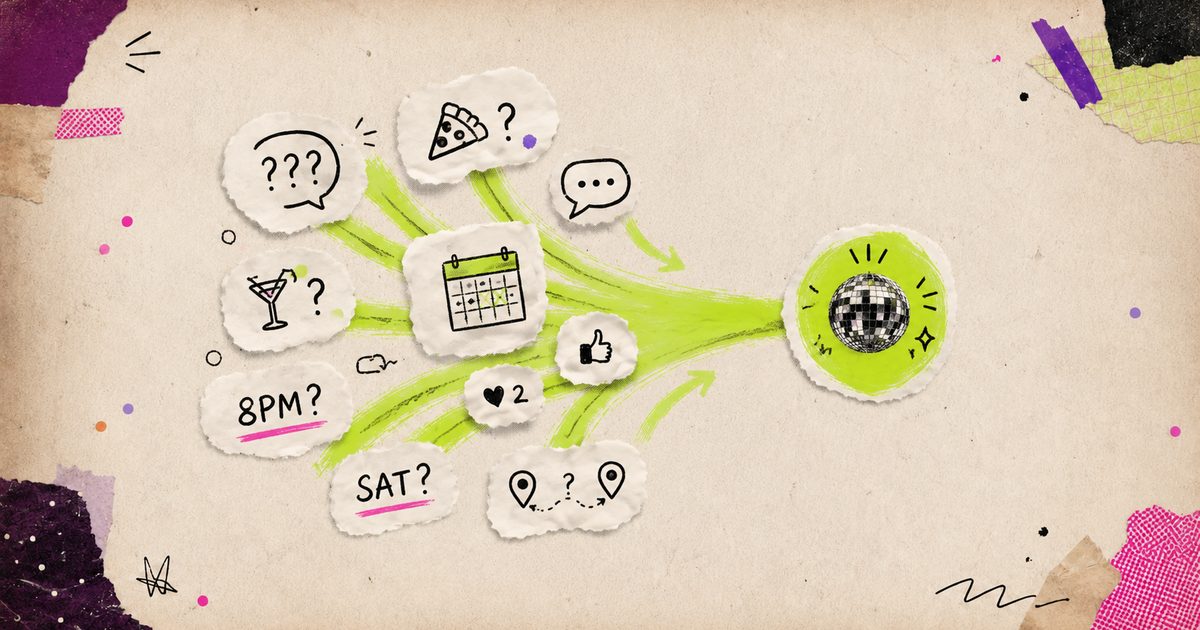
Sixty messages, four gifs, two thumbs up and no decision. Everyone knows this chat. It has a name that was funny in 2021, and it is where nights out go to not happen.
The problem isn't your friends. It's that a group chat is being asked to do three completely different jobs at once, and it's only any good at one of them.
Why group chats fail at planning
A night out needs three things:
1. A decision. Where, when, who's in. 2. Live coordination. Who's actually here, who's late, which room. 3. The aftermath. Photos, apologies, receipts.
A group chat is fine at three. It is bad at one and catastrophic at two.
Decisions die because a chat has no state. There's no answer to "what did we decide", just scrollback. Nobody knows if a thumbs up meant "coming" or "seen it".
Coordination dies because the chat is static and the night isn't. The people in the chat are the people someone guessed would come, four days ago. By midnight, two never showed, one brought a friend, three went somewhere else, and the messages are arriving in a room nobody is reading.
Plan the decision separately from the night
The fix is to stop using one thread for both.
For the decision, be a benign dictator. Groups are terrible at open questions and fine at closed ones.
- Don't ask "what's everyone doing Saturday". Ask "Saturday, this place, 9pm, who's in".
- Give two options maximum, or one option and a deadline.
- Use a poll for anything with more than two answers, so the answer is a count, not a scroll.
- Set a cut-off: "confirming numbers at 6pm Friday". Nights out die of infinite deliberation more than anything else.
- Pin or repeat the plan once decided. One message, all the details, no discussion attached.
For the night itself, stop typing. Once everyone is out, the useful information isn't messages, it's status. Who's out, who's left, where they went. Nobody wants to read eleven messages to work out that Elsa went home at eleven.
The three messages that ruin every night out
- "Where is everyone?" — asked into a chat where half the people are asleep.
- "On my way" — sent 40 minutes before leaving the house, universally understood as fiction.
- "We've moved" — with no location, at the exact moment you arrive at the old one.
Every one of those is a question about live status being asked in a tool that only stores history.
What we'd actually do
Keep the group chat for the plan. Then let the night run itself.
aftrs handles the second half. You set yourself to partying, and the friends you choose can see you're out, live. No "where is everyone", because you can see. No dead thread pinging at 2pm the next day.
Partycast goes further: it builds a chat around the friends you're actually with right now, and changes it as people arrive and leave. Nobody creates it, nobody manages it, nobody starts a second one because the plan moved.
There's more on why the normal apps struggle with this in the best app for nights out.
The short version
- One person proposes, with a place and a time. No open questions.
- Two options maximum, then a deadline.
- Pin the final plan as one message.
- Once everyone's out, use live status instead of typing.
- Let the chat end when the night does.
Plan less, go out more. Get aftrs.
And for where the night usually ends up, see the six types of afters.