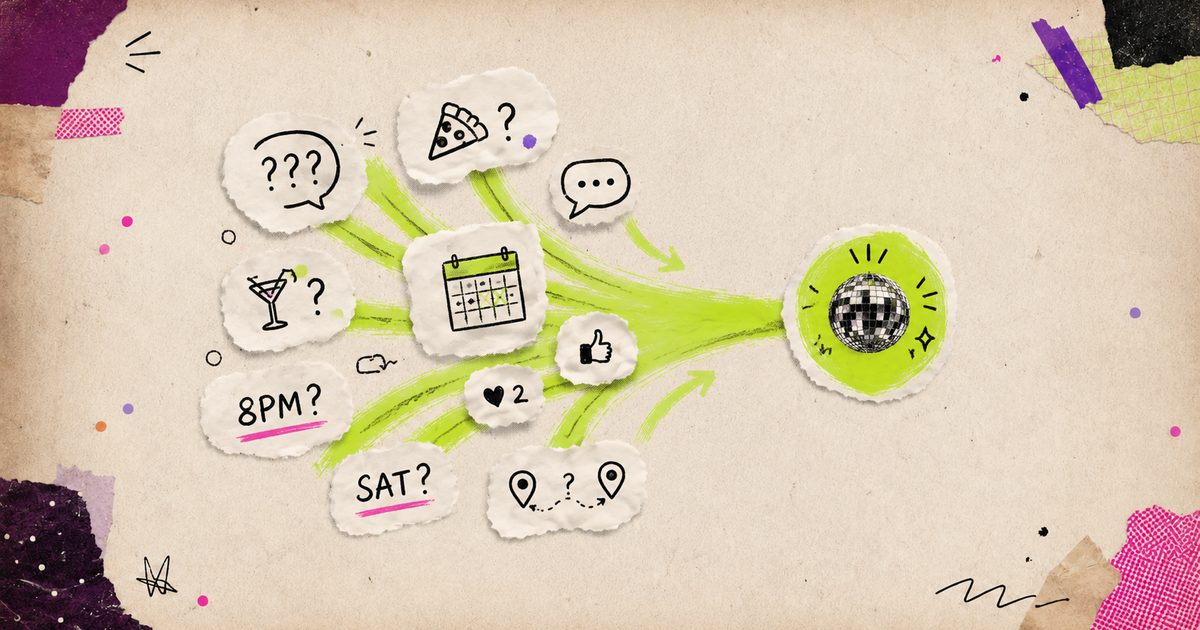
Why does asking “who’s out?” feel so needy?

There's a tiny moment before you press send where you’re putting yourself out there. You’re saying: I want to do something. I want to see people. Please tell me somebody else does too. And now the message is sitting there, waiting.
If nobody replies, what does that mean? Probably nothing. They’re busy. They didn’t see it. They’re already doing something. But there’s still that tiny part of your brain going, brilliant, everyone hates me.
People genuinely type “how to ask a friend to hang out” into Google at six o’clock on a Friday. Grown adults, with friends they love, looking up the wording. That should tell you something about how much weight we’ve loaded onto one small message.
The bit where everyone hates you
So maybe you don’t put it in the group. Maybe you message someone directly instead. But then who? The person you actually want to see? The person most likely to be out? Do you wait for them to reply before messaging someone else, or do you send the same thing to five people at once and risk ending up with five completely different plans? And if somebody doesn’t answer, are they busy or are they ignoring you? Are you allowed to message again? How many unanswered “what are you up to?” messages before you need to move countries?
This is the bit of making plans that gets brushed over. It’s not really about how many messages you have to send. It’s the tiny social negotiation happening underneath every one of them.
You want people to know they can join, but you don’t necessarily want to explicitly invite twenty people. You want to know who’s free, without asking twenty people whether they’re free. You want to say “I’m up for something” without it sounding like “please, for the love of God, somebody make plans with me”. There’s no clean way to do that right now.
Instagram almost gets it
Instagram sort of does it accidentally. You post that you’re somewhere, and there’s an unspoken possibility that someone might reply. “Oh, I’m nearby.” “Wait, you’re there?” “We’re coming.” But posting a photo from somewhere isn’t the same as saying people are welcome to join you. Half the time a Story is just a Story. Maybe you’re having the best night of your life and would rather nobody else appeared.
And posting “anyone doing anything?” publicly on Instagram feels even worse. That has a completely different energy. You’ve gone from casually signalling that you’re out to standing in the town square ringing a bell.
WhatsApp has the opposite problem
Everything is aimed at someone. A person or a group. Even a casual message creates this little moment where people feel they should answer. You’ve asked a question. Now somebody has to deal with it. It’s the same reason planning a night out in the group chat turns into admin, and why people keep looking for something other than WhatsApp for nights out.
WHAT IF YOU DIDN’T HAVE TO ASK FRIENDS TO HANG OUT?
That’s where we think we’ve got the whole thing slightly wrong. A lot of the time you don’t actually want to ask anyone anything. You just want your friends to know something about you right now: Maybe that you're out and up for people joining. Maybe you're looking for something to do. Whatever it is... you let them decide whether that matters to them.
That feels so much more natural because it takes the rejection out of it. Nobody has to say no. Nobody has to leave you on read. Nobody has to come up with “ah sorry babe early one tonight xx” because you never asked them to come in the first place.
They just see what you’re up to. If it lines up with what they want, great. If it doesn’t, nothing happens. That’s the social signal we’ve been thinking about a lot with aftrs.
The point isn’t that people need another place to post about their lives. We definitely have enough of those. It’s more specific than that... what if you could tell your friends what kind of mood you’re in socially, without having to turn it into an invitation or a request?
Then the friend who’s also free can come towards you. The person already doing something can pull you in. The person who isn’t interested doesn’t have to do anything at all.
No “who’s around?” into the void. No working your way through the contacts you think are most likely to say yes. No trying to make an invitation sound casual enough that it doesn’t feel like an invitation. And, maybe most importantly, no pretending you didn’t really care whether anyone replied.
MAKING PLANS WITH FRIENDS SHOULDN’T RELY ON LUCK
We think this is why spontaneous plans often feel so much better than organised ones. Nobody has spent three days finding a date, picking a place, confirming who’s coming and sending “still on for tonight?” at 5pm. You just find out that someone you like is doing something you’d like to do, and suddenly you’re together.
The problem is that spontaneity currently relies on luck. You have to happen to see the Story, happen to message the right person, happen to be in the right WhatsApp group at the right moment. In a city like London, where four of your friends can be out within a mile of you and none of you know it, that’s a lot of nights quietly wasted. It’s the same gap that makes finding afters in London such a lottery.
Aftrs is basically asking whether we can make more of those collisions happen on purpose, without making them feel planned. Set your status, see who’s out and who’s up for something, and let the people who want the same night find you. No asking required.